Match the lids before organising
Lay the clean, cool pans and lids out on a protected surface. Check which lids fit which pans and set aside unmatched pieces for a decision. Do not assume two similar diameters mean the lids are interchangeable, particularly where a product relies on a specific seal.
Measure the cupboard or drawer with the lid handles included. Check the path of hinges and drawer sides as well as the empty shelf space. A lid rack that fits at the back may still stop the largest pan coming out.
Test upright and paired storage
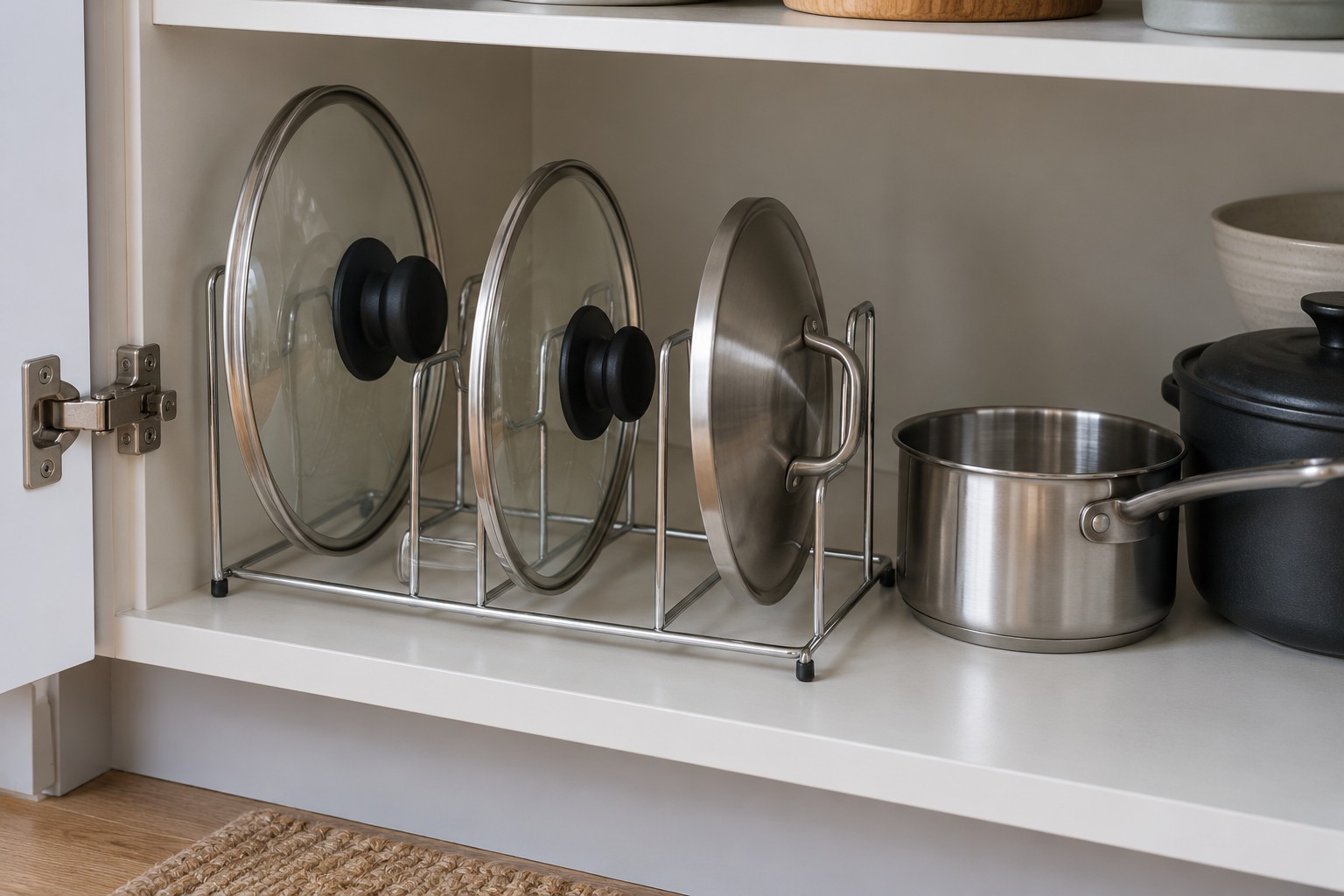
For several similar lids, a stable freestanding divider may make each one easy to reach. Make sure the slots support the lids without pinching glass edges. Put larger, heavier pieces where they cannot topple forward as a smaller lid is removed.
If you have only a few pans, keeping each lid with its own pan may be simpler. Test the arrangement without forcing the handles or resting heavy cookware on fragile parts. Use protective separators only where suitable for the cookware finish.
Keep the cupboard practical
Store the most-used pan and lid near the front. Leave room for your hand around the handle, and check that the arrangement still works after washing up. Avoid adding a door-mounted rack unless the cabinet and fitting instructions specifically support that use and load.
Before you call it done
- Each retained lid has a useful matching pan.
- Glass edges are protected from knocks.
- A single lid can be removed without moving everything.
Know the limit. Follow the instructions for specialist cookware. Never substitute an ordinary lid for a pressure-cooker lid or safety component.